
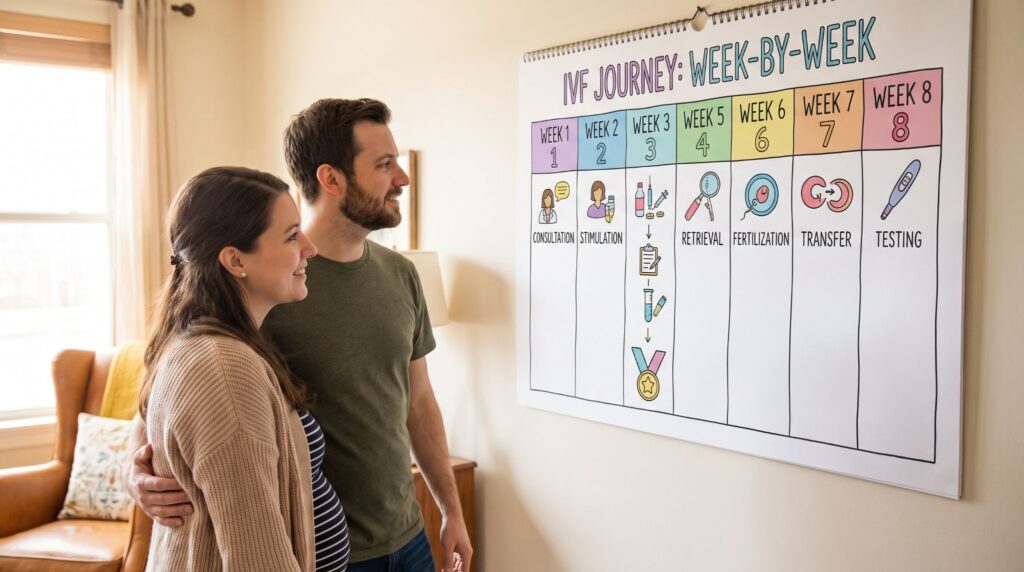
Starting IVF can feel like stepping into the unknown. Between medical jargon, appointment schedules, and emotional ups and downs, most couples simply want one thing: clarity. Understanding the IVF timeline week-by-week can turn anxiety into confidence, helping you mentally and physically prepare for each stage.
At Kasturi Hospitals, one of the trusted names offering IVF treatment in Secunderabad, we believe informed patients make calmer, more resilient patients. Here’s a clear breakdown of what actually happens during an IVF cycle, from your first consultation to the pregnancy test.
Week 1-2: Initial Consultation and Fertility Testing
Before any medication begins, your fertility specialist evaluates your reproductive health through blood tests, ultrasounds, and semen analysis (for male partners). This is also when your doctor reviews your medical history and designs a personalized treatment protocol.
- Hormone panel (AMH, FSH, LH, TSH)
- Pelvic ultrasound to assess ovarian reserve
- Semen analysis for sperm count and motility
- Discussion of medication plan and expected timeline
Choosing the right facility matters here. Working with an established ivf center in Secunderabad ensures accurate diagnostics and a protocol tailored to your specific fertility profile, rather than a one-size-fits-all approach.
Week 2-3: Ovarian Stimulation
This phase involves daily hormone injections (typically 8-14 days) to stimulate the ovaries into producing multiple mature eggs, rather than the single egg released in a natural cycle.
- Daily injections of gonadotropins
- Regular ultrasound monitoring every 2-3 days
- Blood tests to track estrogen levels
- Dose adjustments based on follicle growth
Side effects like bloating or mood swings are common but manageable. Your medical team closely tracks follicle size to determine the ideal moment for egg retrieval.
Week 3: Trigger Shot and Egg Retrieval
Once follicles reach optimal size, a “trigger shot” is administered to finalize egg maturation. Egg retrieval happens 34-36 hours later, under light sedation, and takes only 15-20 minutes.
- Trigger injection timed precisely
- Egg retrieval via minor outpatient procedure
- Same-day discharge with rest advised
- Sperm sample collected the same day (fresh or frozen)
Week 3-4: Fertilization and Embryo Development
In the lab, retrieved eggs are fertilized using conventional IVF or ICSI (Intracytoplasmic Sperm Injection). Embryologists then monitor embryo development for 3-5 days.
- Day 1: Fertilization confirmation
- Day 3: Cleavage-stage embryo check
- Day 5-6: Blastocyst formation
- Optional genetic testing (PGT) if recommended
This stage relies heavily on lab quality and embryologist expertise, which is why the credentials of your chosen facility matter significantly.
Week 4-5: Embryo Transfer
The healthiest embryo (or embryos) is transferred into the uterus using a thin catheter. This is a painless, quick procedure that doesn’t require anesthesia.
- Fresh transfer (Day 3 or Day 5) or frozen embryo transfer (FET)
- No sedation needed; procedure takes minutes
- Light rest recommended afterward
- Progesterone support begins to prepare the uterine lining
Week 5-6: The Two-Week Wait and Pregnancy Test
The period between embryo transfer and the pregnancy test—often called the “two-week wait”—is emotionally the hardest part. A blood test (Beta hCG) around day 10-14 post-transfer confirms pregnancy.
- Avoid strenuous activity but maintain light movement
- Continue prescribed progesterone support
- Beta hCG blood test for confirmation
- Follow-up ultrasound at 6-7 weeks if positive
Why the Right Hospital Makes the Difference
IVF success isn’t just about protocols—it’s about the team executing them. Look for a facility that combines advanced embryology labs with compassionate patient care. As a recognized Gynecology hospital in Secunderabad, Kasturi Hospitals integrates fertility treatment with comprehensive women’s healthcare, ensuring continuity of care before, during, and after your IVF journey.
Being part of a best multispeciality hospital in Secunderabad also means access to allied specialists—endocrinologists, urologists, and geneticists—under one roof, which can be critical for complex fertility cases requiring a coordinated approach.
Key Takeaways
- IVF typically spans 4-6 weeks from stimulation to pregnancy test
- Each phase requires close monitoring, not guesswork
- Lab quality and doctor expertise directly influence outcomes
- Emotional support during the “two-week wait” is as important as medical care
Frequently Asked Questions (FAQs)
1. How long does one complete IVF cycle take?
A full IVF cycle, from ovarian stimulation to the pregnancy test, generally takes 4 to 6 weeks. Frozen embryo transfer cycles may extend the timeline slightly.
2. Is IVF painful?
Most steps involve mild discomfort rather than pain. Injections may cause minor soreness, and egg retrieval is done under sedation, so pain is minimal.
3. What is the success rate of IVF?
Success rates vary based on age, egg quality, and underlying fertility issues, typically ranging between 30-50% per cycle for women under 35. A consultation with your fertility specialist gives a personalized estimate.
4. Can I work during an IVF cycle?
Yes, most patients continue normal routines during stimulation. Rest is usually advised only around egg retrieval and immediately after embryo transfer.
5. How many embryo transfer attempts are typically needed?
This varies by individual. Some conceive on the first transfer, while others may need 2-3 attempts. Frozen embryos from the same cycle can be used for subsequent transfers without repeating stimulation.
6. What should I look for in an IVF center?
Prioritize lab accreditation, embryologist experience, transparent success rates, and a doctor who explains each step clearly. An established ivf center in Secunderabad with integrated diagnostic support offers added convenience.
7. Does age affect IVF success?
Yes, egg quality and quantity decline with age, particularly after 35. Earlier consultation generally improves outcomes.
8. What happens if the first IVF cycle fails?
Your doctor reviews the cycle, adjusts the protocol if needed, and may recommend additional testing before the next attempt. Frozen embryos, if available, can often be used without a full stimulation cycle.
9. Are there lifestyle changes that improve IVF success?
Maintaining a healthy weight, avoiding smoking and alcohol, managing stress, and following your doctor’s supplement recommendations can positively influence outcomes.
10. How do I book a consultation at Kasturi Hospitals?
You can visit kasturihospitals.com to schedule a consultation with our fertility specialists, or contact the hospital directly for an in-person appointment.