
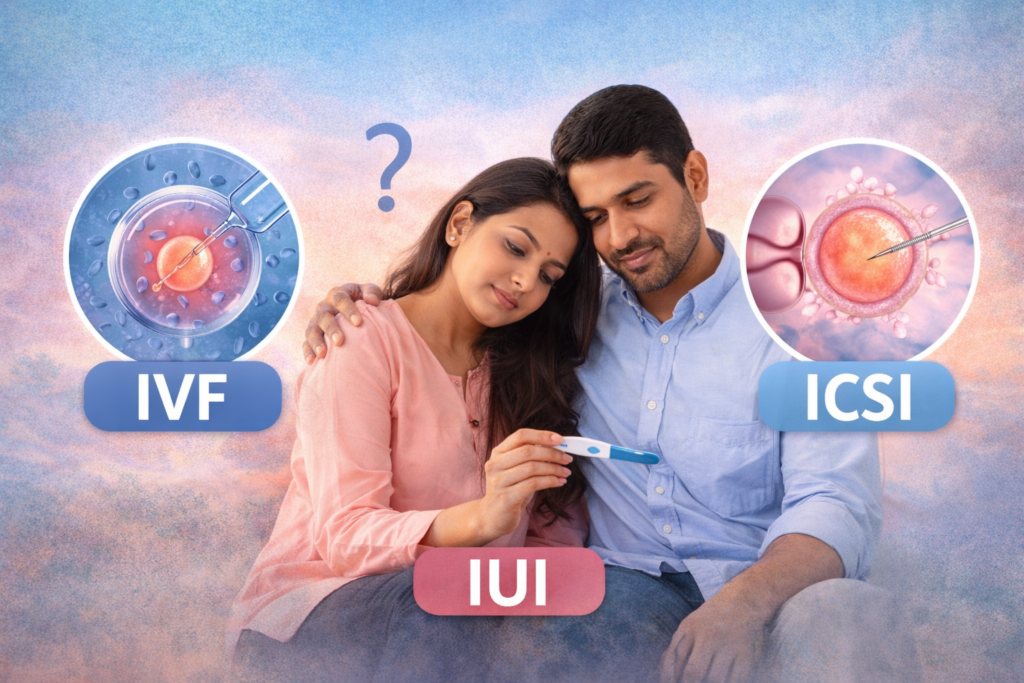
Nobody Tells You How Confusing This Part Is
You’ve finally decided to seek help. That in itself takes courage. But then you sit across from a doctor, and suddenly there are three different treatment names being thrown at you — IVF, IUI, ICSI — and you leave the clinic more confused than when you walked in.
You’re not alone. This is one of the most common experiences couples face when they first explore fertility treatment. The options sound similar, the abbreviations blur together, and it’s genuinely hard to know where to start.
So let’s break it down — simply, honestly, and without the jargon.
First, Why Do These Options Even Exist?
Because Infertility Isn’t One-Size-Fits-All
Every couple’s fertility journey is different. The reason one couple struggles to conceive may be completely different from another’s. That’s why there isn’t one single treatment — there are several, each designed to address a specific underlying cause.
The goal of any fertility treatment is the same: to help you have a baby. But the path to get there depends on what’s actually going on — whether that’s a sperm count issue, a blocked fallopian tube, poor egg quality, unexplained infertility, or something else entirely.
At Kasturi Hospital, recognised as one of the Best Multispeciality Hospitals in Hyderabad, the fertility team takes time to understand the full picture before recommending any treatment. That matters more than most people realise.
IUI – The Least Invasive Starting Point
What It Is
IUI stands for Intrauterine Insemination. In simple terms, a doctor takes a prepared sperm sample and places it directly inside the uterus — closer to the egg — at the exact time of ovulation. It’s a straightforward procedure, done in a clinic, and takes only a few minutes.
Who It’s For
IUI tends to work well for couples where the sperm count is slightly low, sperm motility is an issue, or there’s no clear medical reason for not conceiving (what doctors call unexplained infertility). It’s also commonly used for single women or same-sex couples using donor sperm.
It’s the least invasive option, the most affordable, and often the first thing doctors suggest before moving on to more involved treatments. Success rates are lower than IVF, but for the right candidate, it can absolutely work.
IVF – The One Most People Have Heard Of
What It Is
IVF — In Vitro Fertilisation — is what most people picture when they think of fertility treatment. The process involves stimulating the ovaries to produce multiple eggs, retrieving those eggs, fertilising them with sperm in a laboratory, and then transferring one or more resulting embryos back into the uterus.
It sounds like a lot — and honestly, it is. IVF is a more intensive process, both physically and emotionally. But it also has significantly higher success rates than IUI, which is why it’s the go-to option for many couples.
Who It’s For
IVF is typically recommended when IUI hasn’t worked, when there are blocked fallopian tubes, more significant sperm problems, endometriosis, or when a woman’s egg reserve is low. It’s also the foundation for treatments like genetic screening of embryos before transfer.
ICSI – IVF’s More Targeted Sibling
What It Is
ICSI stands for Intracytoplasmic Sperm Injection. It’s essentially a specialised version of IVF — with one key difference. Instead of leaving the sperm and egg to fertilise naturally in a dish, a single sperm is selected and injected directly into the egg.
It sounds precise — because it is.
Who It’s For
ICSI is the treatment of choice when there’s a significant male fertility issue — very low sperm count, poor sperm shape or movement, or when sperm has been surgically retrieved. It’s also used when previous IVF cycles haven’t resulted in fertilisation.
For couples where the male partner’s fertility is the primary concern, ICSI can make all the difference.
So, How Do You Decide?
Honestly? You don’t have to decide on your own. That’s what the fertility team is there for.
The right treatment depends on your test results, your age, how long you’ve been trying, and a number of other factors that only a proper evaluation can reveal. What works brilliantly for one couple may not be the right starting point for another.
At Kasturi Hospital in Secunderabad, the approach is always individual-first. Dr. M. Kalpana and the fertility team don’t push a standard protocol — they look at your specific situation and recommend what genuinely gives you the best chance.
The honest truth is this: whether you need IUI, IVF, or ICSI, getting the diagnosis right is the most important step. Everything else follows from there.
Your Next Step Doesn’t Have to Be Overwhelming
If you’ve been wondering which treatment is right for you, start with a consultation. One conversation with the right doctor can replace months of confusion, second-guessing, and late-night internet searches that leave you more anxious than informed.
Kasturi Hospital — one of the most trusted names in fertility care and widely regarded as the Best Multispeciality Hospital in Hyderabad — is here to help you take that next step with clarity and confidence.
Frequently Asked Questions
Q. What is the difference between IVF and ICSI?
IVF allows the sperm and egg to fertilise naturally in a lab, while ICSI involves injecting a single sperm directly into the egg — making it more suitable for severe male infertility cases.
Q. Is IUI painful or invasive?
IUI is a quick, minimally invasive procedure done in a clinic with little to no discomfort — most patients resume normal activity the same day.
Q. How do I know which fertility treatment is right for me?
A fertility specialist will assess both partners through blood tests, scans, and semen analysis before recommending the most suitable treatment based on your specific diagnosis.